International Selling on eBay: Tariffs, Country of Origin, and What US Sellers Must Get Right
Complete US eBay international shipping guide covering tariffs, Country of Origin rules, customs forms, HS codes, AES filing, anti-dumping duties, and compliance risks.
March 26, 2026

US eBay International Shipping Guide: Tariffs, Country of Origin, and Compliance Best Practices
International sales are not declining because demand disappeared.
They’re declining because friction increased.
Tariffs tightened. Customs enforcement automated. eBay structured data got stricter. Buyers now see import charges more clearly, and react to them.
If you are a US-based eBay seller shipping internationally, you are now operating inside three overlapping systems: US export regulation, foreign import and tariff enforcement, and eBay’s structured data framework. International selling is no longer just about logistics. It is about accuracy.
The sellers who understand that shift adjust and protect margin.
The sellers who ignore it blame “slow international traffic” or "rising shipping costs".
In this article, we are going to break down what Country of Origin really means, how tariffs affect conversion, what mistakes trigger customs delays, when AES filing applies, how eBay’s international hub changes seller responsibility, what anti-dumping duties are, whether de minimis thresholds can be used strategically, and when it may make sense to restructure your entire international fulfillment model.
Disclaimer: This article is for educational purposes only and does not constitute legal, tax, or customs advice. International trade regulations change frequently. Sellers should consult a licensed customs broker or trade professional for advice specific to their business.

Tariffs Affect Conversion Even If the Buyer Pays
International buyers are responsible for import duties, VAT, tariffs, and brokerage fees charged by their country.
The seller does not pay those charges.
But the seller absolutely feels them.
Buyers evaluate landed cost. That includes your item price, your shipping cost, and whatever their government and carrier add at entry. When tariff enforcement tightens or rates rise, buyer hesitation increases. That shows up in lower international conversion rates.
You cannot control foreign tariff law. But you control price structure, sourcing decisions, and documentation accuracy. That determines how competitive your total landed offer looks in that market.
Country of Origin: The Most Common Seller Mistake
Country of Origin is not where you purchased the product. It is where the product was manufactured.
If you buy inventory from a distributor in the United States, but the product was manufactured in China, the Country of Origin is China. The supplier location does not matter.
This applies regardless of condition. New items require origin declaration. Used items require origin declaration. Refurbished items require origin declaration.
If you sell a used auto part that was originally manufactured in Germany, the Country of Origin remains Germany.
Packaging does not change origin. Reboxing, repackaging, open-box condition, or refurbishment do not reset origin. The manufacturing country stays the same.
Private labeling also does not change origin. Branding a product under your own name does not convert it into US origin.
Substantial Transformation and Custom Products
Custom-made products follow the substantial transformation rule.
Country of Origin equals the country where the final substantial transformation occurred. Substantial transformation means the product’s name, character, or use was meaningfully changed.
If a diamond is mined in Africa but a ring is manufactured in the United States, and that transformation meets legal standards, the Country of Origin may be United States.
However, simple assembly of imported parts often does not qualify. “Assembled in USA” is not automatically “Made in USA” under customs law.
If you are unsure, consult a customs broker. Guessing creates risk.
What Incorrect Declarations Actually Cause
Incorrect declarations create real operational damage.
If origin does not match packaging or inspection findings, customs can hold the shipment. If declared value appears artificially low, it can trigger reassessment. If classification and description conflict, packages may be delayed.
Consequences include customs delays, returned packages, buyer disputes, negative feedback, carrier fees, and in serious cases, penalties.
Most sellers do not get fined. They lose margin through friction.
Accuracy protects speed. Speed protects conversion.
HS Codes and Classification Risk
Customs duties are calculated using HS (Harmonized System) codes.
Misclassification can materially change duty exposure. Two products that look similar may fall under different classifications and carry different duty rates.
If you ship direct and guess the classification, you are operating blind.
If you ship through eBay’s international hub, classification still flows from structured listing data. You are not filling out customs forms manually in that case, but your listing data still drives downstream classification.
To understand why HS codes matter, consider a few examples. A cotton t-shirt and a synthetic performance shirt may look similar, but they fall under different HS classifications and can carry different duty rates. A leather wallet and a synthetic wallet can also fall into different classifications with different tariff exposure. Even something as simple as a “toy” versus a “collectible decorative item” can change classification and, therefore, duty.
If you ship directly using carriers, you are responsible for accurate customs documentation. The most commonly used forms include:
• USPS Customs Form 2976 (CN22) and Form 2976-A (CN23)
• UPS Commercial Invoice (for international shipments)
• FedEx International Air Waybill and Commercial Invoice
These forms are available directly through each carrier’s website or shipping portal and must include accurate description, value, weight, and Country of Origin.
If you are unsure of classification, consult the U.S. Harmonized Tariff Schedule database before shipping.
Anti-Dumping and Trade Policy Exposure
Some products from specific countries are subject to additional duties beyond standard tariff rates. These may include anti-dumping duties or trade policy adjustments.
Even though the buyer pays those duties, they impact demand. If one manufacturing country faces additional tariffs while another does not, sourcing strategy becomes a competitive advantage.
For example, certain steel products from China have been subject to anti-dumping duties in addition to normal tariff rates. Some aluminum products, solar panels, and specific industrial components have faced similar additional duties depending on country of origin. In apparel, certain synthetic fiber products have faced higher duty exposure compared to natural fibers.
These additional duties do not affect every product category, but when they apply, they materially change landed cost and buyer demand.
Can Duties Be Paid Twice? Understanding Duty Drawback
Some sellers ask whether duties paid when importing goods into the United States can be offset if the same goods are later exported and imported into another country.
In certain cases, U.S. Customs allows for duty drawback programs, where previously paid import duties may be partially refunded when goods are re-exported. However, duty drawback programs require formal filing, documentation, and compliance with strict rules. They are typically used by larger importers and exporters, not casual sellers.
Drawback application form (CBP Form 7551)
Separately, the destination country will still assess its own import duties when the item enters that market. There is no automatic global “credit” that prevents duties from being assessed twice across different countries.
Brokerage Fees and Buyer Confusion
Brokerage fees are charged by carriers such as UPS, FedEx, and DHL for customs paperwork and government clearance. These are not seller-controlled fees.
Buyers often do not understand this distinction. They assume the seller added the charge.
Every international listing should clearly state that international buyers are responsible for import duties, taxes, and brokerage fees charged by their country. It reduces surprises and lowers dispute rates.
BUYER DISCLAIMER SENTENCE
“International buyers are responsible for any import duties, taxes, VAT, and brokerage fees charged by their country. These charges are not included in the item price or shipping cost and are determined by your local customs authority.”
You can copy and paste this statement into your shipping policies and listing descriptions to reduce misunderstandings and international disputes.
Returns and Duty Recovery
International returns are more complex than domestic returns.
Duties are usually not automatically refunded. Buyers often must apply for duty reimbursement through their customs authority. Brokerage fees are frequently non-refundable.
If the return is caused by incorrect seller declaration, expect resistance. If it is buyer remorse, duty recovery responsibility usually falls on the buyer.
This is another reason why documentation accuracy protects profit.
Splitting Price and Shipping Does Not Avoid Duty
Some sellers attempt to lower item value and increase shipping cost to reduce duty exposure.
Most customs authorities calculate duty using total transaction value, which often includes item price plus shipping.
Artificial manipulation can trigger inspection and reassessment. If customs determines that value was intentionally under-declared, penalties can follow.
This is not a loophole. It is exposure.
De Minimis Thresholds and Strategic Pricing
Each country sets a de minimis threshold; the value under which duty may not apply.
These thresholds vary widely and change over time. Some countries apply separate thresholds for duty and VAT.
If your natural sale price falls below a threshold, buyers may avoid duty. That can influence bundling decisions and SKU promotion strategy.
However, declared value must reflect actual sale price. You should never misdeclare value to remain under a threshold.
Understanding thresholds is strategic. Manipulating them is risky.
The Supreme Court’s IEEPA Ruling 2026 Tariff Refunds
In 2026, international trade policy experienced a significant shift following the U.S. Supreme Court’s ruling related to tariffs imposed under the International Emergency Economic Powers Act (IEEPA). The decision created the potential for tariff refunds on certain imported goods that were previously subject to emergency trade measures.
For eBay sellers who import merchandise into the United States before exporting it internationally, this development may create opportunities to recover previously paid duties or reassess sourcing strategies. While not all imports qualify, sellers who regularly import goods should review their eligibility and consult with trade professionals or customs brokers.
Understanding how tariff refunds and trade rulings affect import costs can influence pricing, sourcing, and international competitiveness.
To learn more about eligibility and refund opportunities, read the full breakdown here https://www.mylisterhub.com/articles/tariff-refund-for-ebay-sellers-in-2026
AES Filing for High-Value Direct Shipments
If you ship directly from the United States and the shipment exceeds certain value thresholds per Schedule B classification, you may be required to file Electronic Export Information through the Automated Export System (AES).
Many sellers overlook this requirement. If you regularly ship high-value items directly overseas, especially over $2,500 per classification, you should understand whether AES filing applies.
When shipping through eBay’s international hub, much of the export documentation is handled within the program structure, reducing administrative burden. But awareness of export reporting requirements remains important if you ship direct.
Electronic Export Information filings are submitted through the U.S. Census Bureau’s Automated Export System (AES) via the ACE portal. Sellers who ship high-value goods directly can register and file through the ACE system at the official U.S. Customs and Border Protection website. If you regularly export shipments over $2,500 per Schedule B classification, you should review the AESDirect filing requirements on the CBP website.
Hub Shipping vs Direct Shipping: Operational Differences
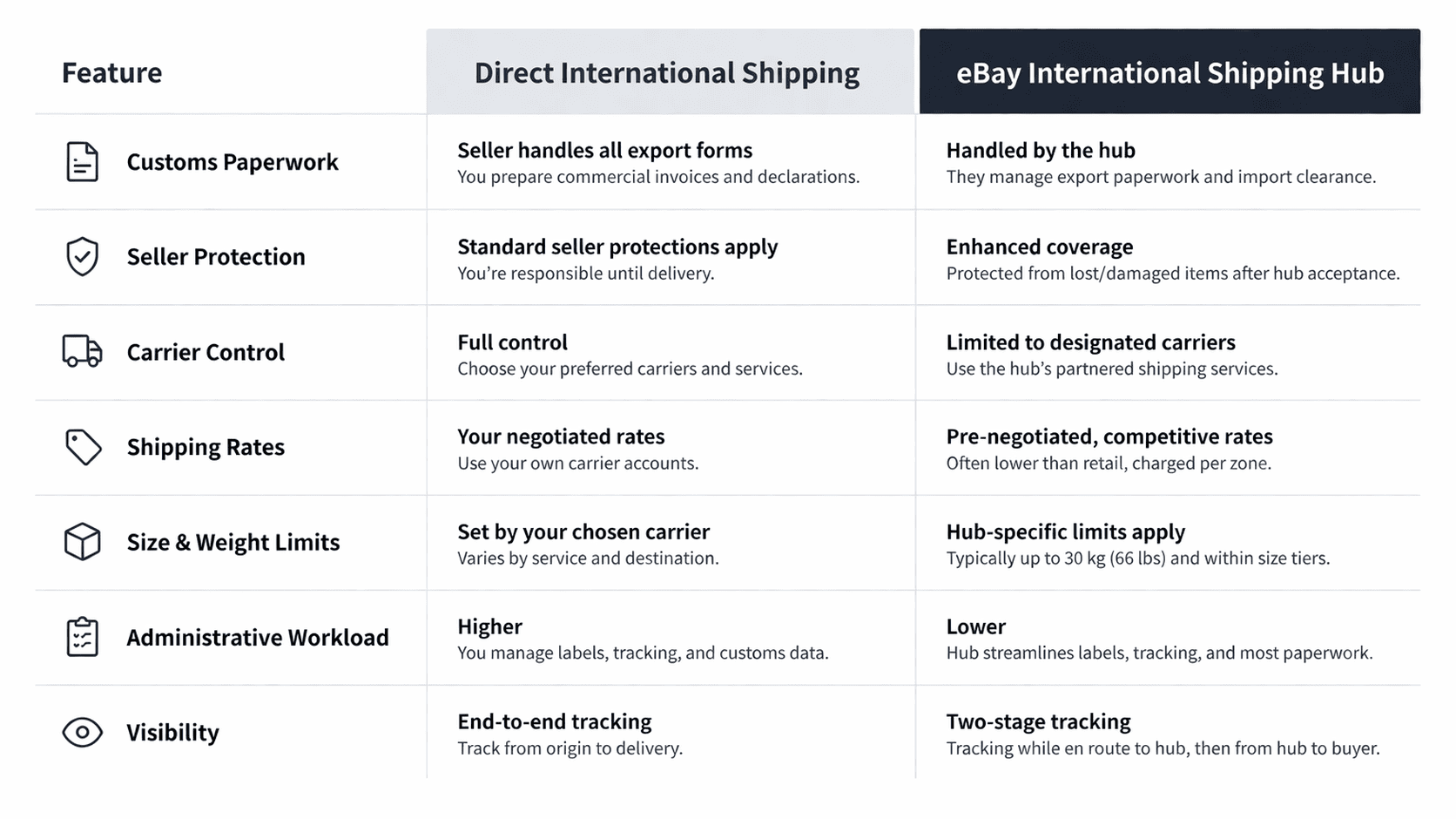
Shipping through eBay’s international hub simplifies the process and shifts certain risks.
When you ship to the domestic hub:
• eBay prepares customs documentation for the international leg
• Duties and taxes are often calculated upfront for buyers
• Once the item arrives at the hub, seller protection increases
• eBay assumes responsibility for international transit issues in many cases
This reduces the seller's administrative exposure.
However, tariffs still apply. Country of Origin still matters. Declared value still matters.
Not every seller or SKU is automatically eligible for the international hub program. Eligibility may depend on account performance metrics and service standards. There are also practical size and weight limits. Heavier or oversized items may not qualify for hub processing.
Direct shipping provides more control but requires the seller to complete customs documentation and manage compliance personally.
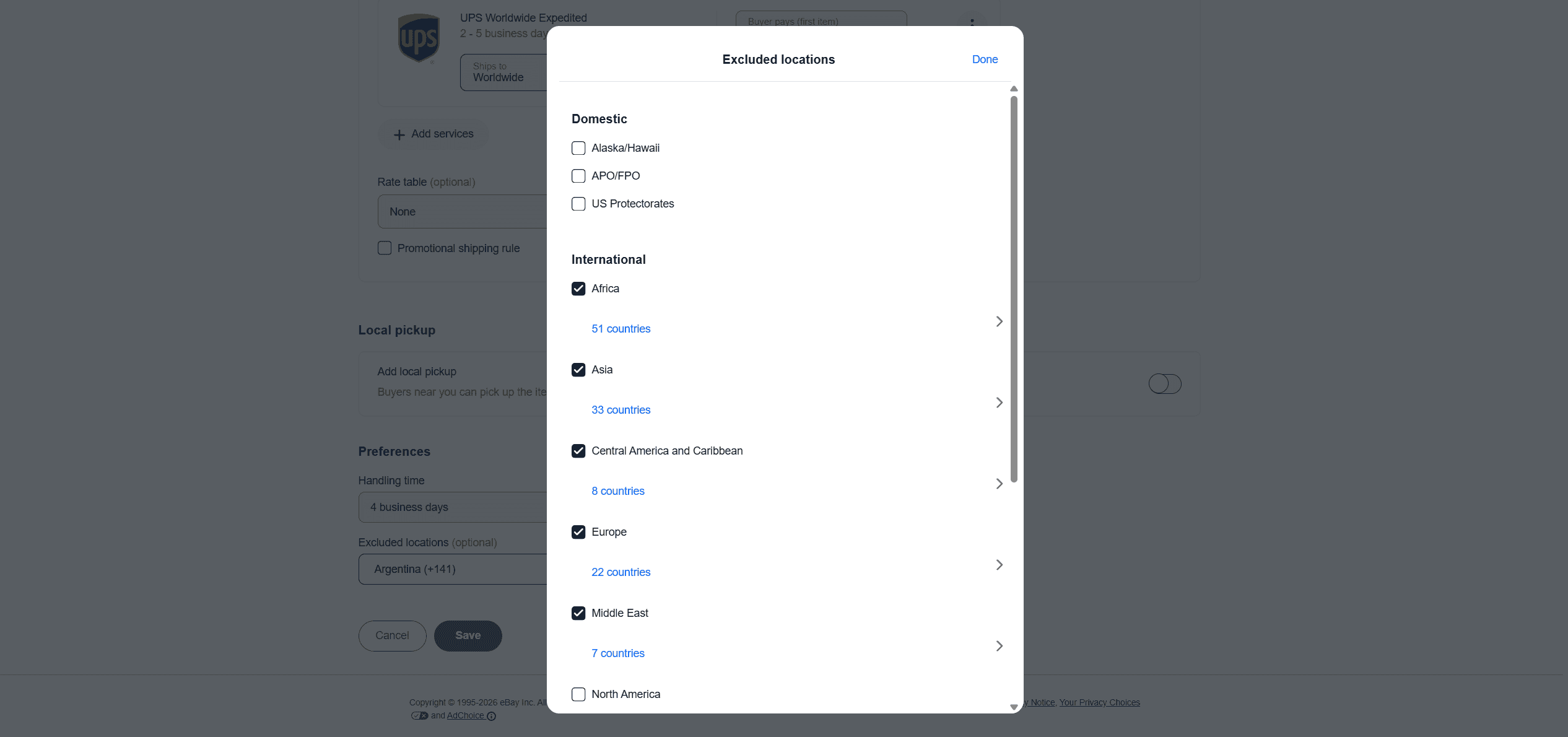
Sellers can also exclude specific countries from international shipping settings if certain destinations create consistent tariff friction or return risk.
The decision between hub and direct shipping should be based on operational capacity and risk tolerance.
There can be cost benefits when using eBay International Shipping. Because eBay aggregates international volume, negotiated carrier rates may be competitive compared to individual seller-negotiated international rates. Duties are often calculated upfront for buyers, which can reduce surprise and improve checkout conversion.
Sellers who are eligible can opt into eBay International Shipping through their Shipping Preferences inside Seller Hub. Availability depends on seller performance standards and account eligibility. Click here to opt in to eBay International Shipping.
However, there are disadvantages. Not all items qualify due to size and weight limits. Certain categories may be restricted. You have less control over the final international carrier selection. Processing time may increase slightly due to hub routing. And because eBay handles the international leg, you have limited visibility once the item leaves the domestic hub.
Choosing hub versus direct shipping is an operational trade-off between control and administrative simplicity.
There is no tariff discount for using the hub. Tariffs are determined by the destination country's law.
Offshore Fulfillment Strategy for High-Volume Sellers
For larger sellers significantly impacted by international friction, there is another strategic option.
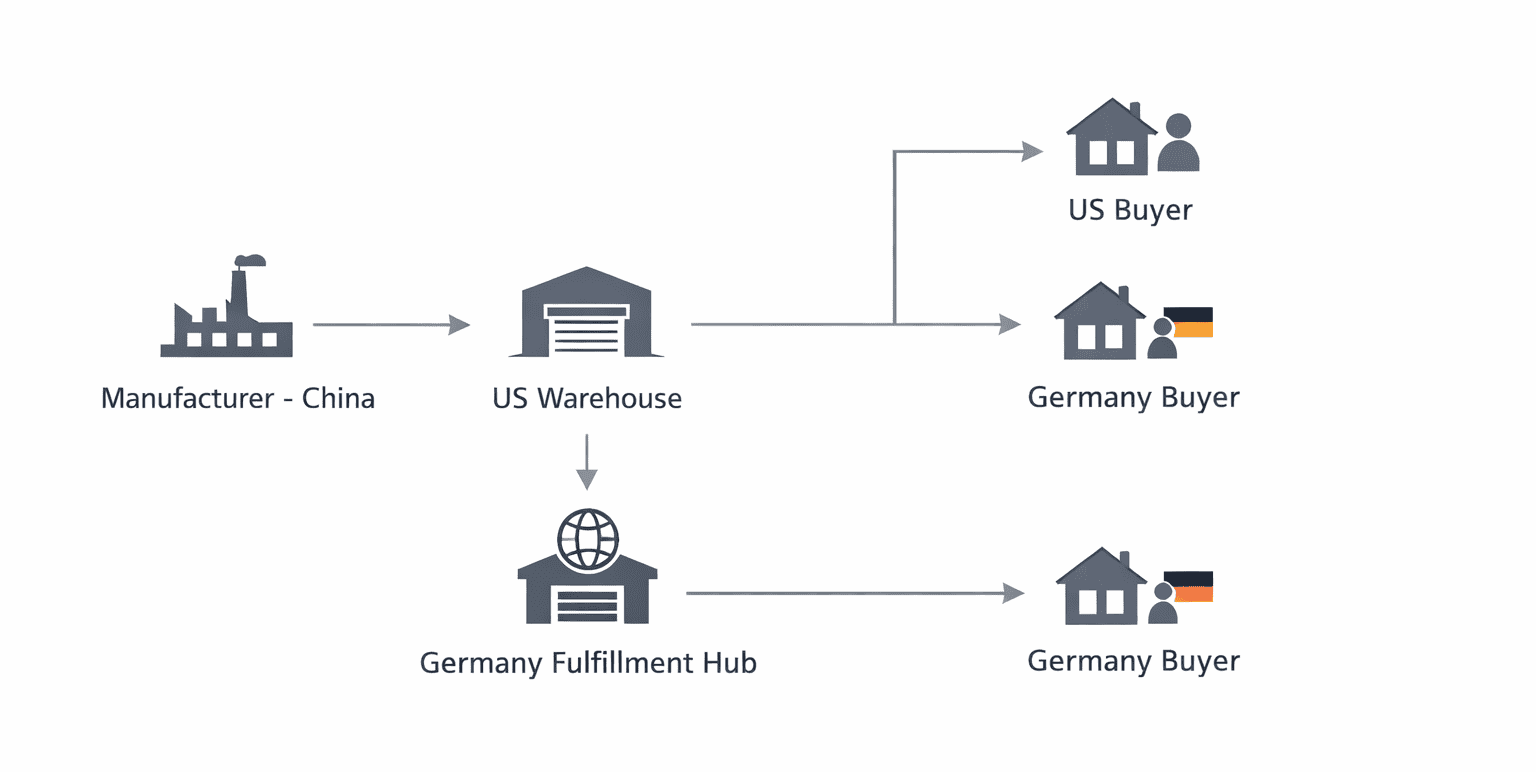
If you manufacture in China, store inventory in the United States, and ship heavily to Germany, you are effectively moving goods from China to the US and then back to Europe.
In some cases, it may be operationally smarter to ship bulk inventory directly from the manufacturer to a third-party fulfillment center in the target country or region.
For example, if Germany represents a large percentage of your international volume, warehousing inventory inside Germany may eliminate double handling, reduce shipping time, improve buyer trust, and potentially optimize duty exposure depending on trade agreements and VAT registration structure.
This approach introduces complexity, including VAT registration, local compliance, and fulfillment management. It is not for small sellers. But for high-volume operators with concentrated international demand, it can materially improve delivery speed and competitiveness.
When to Stop Selling Internationally
International sales should be a margin decision.
If return rates are high, customs delays are frequent, margins shrink after tariff friction, or compliance time exceeds profit, focusing on domestic sales may be smarter.
International revenue is optional. Margin is not.
Operational Discipline for Multi-SKU Sellers
If you manage large catalogs, origin tracking cannot rely on memory.
You need internal documentation linking supplier, SKU, manufacturing origin, and listing data. If suppliers change, listings must update. If batches differ by origin, they must be separated or standardized properly.
Origin inconsistency at scale becomes systemic risk.
International selling is no longer “turn it on and forget it.” It requires structured control.
Where Structured Control Matters (And Where MyListerHub Helps)
If you manage a small catalog, you can manually check origin fields and shipping settings.
If you manage hundreds or thousands of SKUs, manual checking becomes exposure.
International compliance risk is rarely dramatic. It is usually quiet drift:
A supplier changes manufacturing location.
A batch comes from a different country.
A listing is duplicated without updating origin.
A return policy is inconsistent across stores.
Over time, inconsistencies accumulate.
This is where structured listing control matters.
With MyListerHub, sellers can:
Bulk edit Country of Origin across large groups of listings instead of opening each SKU individually. If you discover missing origin data, you can update it across your catalog in minutes.
Use error detection to identify listings that are missing Country of Origin or contain incomplete item specifics that may affect international eligibility. Instead of guessing which listings are exposed, you can scan and fix them.
Identify when a potential buyer is international inside the messaging system, giving you early awareness when tariff-related questions may arise.
Update shipping and return policies in bulk using business policy controls. If you decide to restrict certain countries or adjust return handling for international orders, you do not need to manually edit each listing.
This is not about automation for convenience.
It is about preventing compliance drift at scale.
When international selling becomes a structured operational process instead of a manual habit, margin becomes more predictable.
Common Questions Sellers Ask About US Tariffs and eBay Country of Origin Rules
Can I avoid paying duties twice if I already paid when importing into the U.S.?
No. The destination country will still assess its own import duties. In some cases, sellers may qualify for a U.S. duty drawback refund, but this requires formal filing with CBP.
Does using eBay International Shipping reduce tariffs or import duties?
No. Tariffs are determined by the destination country’s law and the product’s Country of Origin and HS classification. eBay’s international hub simplifies paperwork and may improve seller protection, but it does not reduce duty exposure.
If my international sales dropped, what should I review first?
Most international slowdowns trace back to data accuracy, or total landed price, not the disappearance of demand. Check three things:
(1) Are all listings properly declaring Country of Origin?
(2) Has landed cost become uncompetitive due to tariffs or brokerage fees?
(3) Are your SKUs eligible for eBay International Shipping, or restricted by size, weight, or category?

by Alon Dostov