Buy From Salvation Army to Sell on eBay: Seller Guide
Learn how to buy from Salvation Army to sell on eBay with sourcing tips, pricing strategy, and listing automation.
May 29, 2026
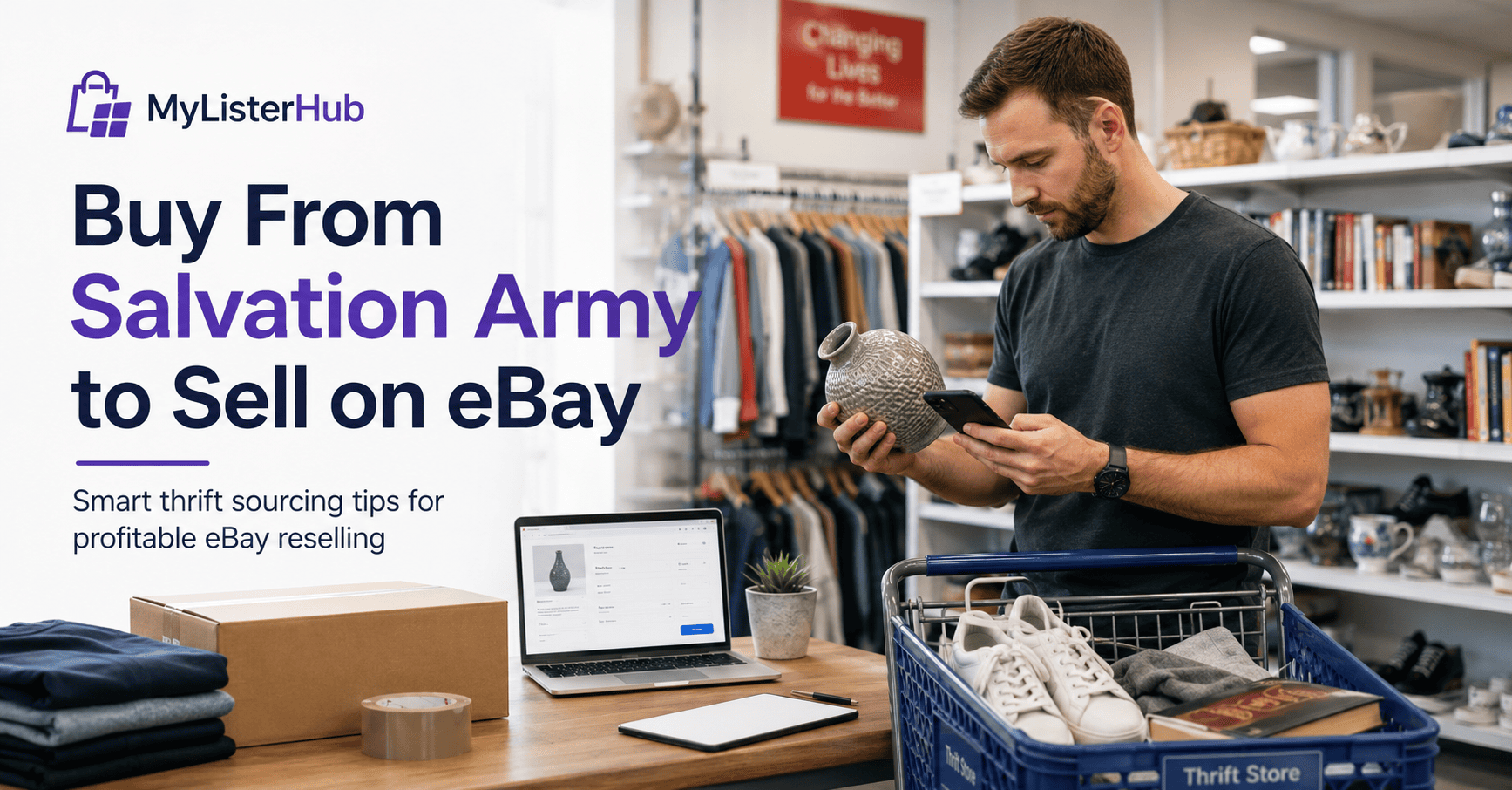
Buy From Salvation Army to Sell on eBay: A Real Seller’s Guide to Finding Profit
Buying from Salvation Army to sell on eBay can be a smart way to source inventory, but only if you treat it like a business. Walking into a thrift store and buying random items because they look cheap is not a strategy. That is how sellers end up with shelves full of dead inventory.
The real money is made before the item ever gets listed. It is made when you pick the right item, at the right price, with enough demand, clean condition, and realistic profit after shipping and fees.
If you are trying to build a serious eBay store, MyListerHub can help you move faster once those items are ready to list. You can learn more about our eBay seller tools on the MyListerHub homepage or explore our full eBay listing software platform.
This guide breaks down exactly how to buy from Salvation Army to sell on eBay, what categories are worth checking, what items to avoid, how to research sold comps, and how to turn thrift finds into listings that actually have a chance to sell.
Why Salvation Army Can Be a Good Place to Source eBay Inventory
Salvation Army thrift stores receive donations from local communities. That means every location is different. One store may be full of clothing and shoes. Another may have better books, electronics, home goods, or collectibles.
That randomness is exactly why thrift sourcing still works.
The opportunity comes from pricing gaps. A thrift store may price a jacket as just another used jacket. But on eBay, that same jacket may have value because of the brand, size, color, model, style, or discontinued design.
That is where sellers can find profit.
Salvation Army can be useful for eBay sellers because:
- Inventory changes often.
- Prices can leave room for resale margin.
- You can source many different categories in one trip.
- Local donations create unique finds.
- New sellers can learn without spending thousands upfront.
However, this does not mean everything is worth buying. Cheap does not mean profitable. A $4 item that never sells is worse than a $25 item that flips quickly for $80.
For more sourcing ideas beyond Salvation Army, read this related guide from MyListerHub: Where to Source Items to Sell on eBay.
The Seller Mindset: Stop Shopping, Start Sourcing
This is the part most beginners get wrong.
Shopping is emotional. Sourcing is analytical.
A shopper says, “This looks cool.”
A reseller says, “What did this sell for recently, how many are listed, what condition is mine in, what will shipping cost, and how much will I net after fees?”
If you want to buy from Salvation Army to sell on eBay, you need to think like a reseller from the second you walk through the door.
Before buying anything, ask:
- Is there proven demand?
- Are sold comps strong?
- Is the item clean enough to sell?
- Is it easy to photograph?
- Is it easy to ship?
- Will the profit be worth my time?
- Can I list it quickly?
If the answer is not clear, leave it behind.
The fastest way to build a bad eBay business is to buy too many “maybe” items. Maybe it sells. Maybe the stain comes out. Maybe the shipping is not that bad. Maybe the brand is worth something.
That is trash logic for reselling. Data beats guessing.
Best Items to Buy From Salvation Army to Sell on eBay
The best items are usually not random generic products. The best thrift flips are specific. Buyers search for brands, models, sizes, patterns, part numbers, materials, and discontinued items.
Here are the main categories worth checking.
1. Clothing
Clothing can be strong because it is easy to store and ship. But it is also competitive, so you need to be selective.
Look for:
- Outdoor brands
- Workwear
- Vintage jackets
- Quality denim
- Wool, leather, cashmere, and linen
- Unique sizes
- Discontinued styles
- Sportswear
- Branded hoodies and sweatshirts
Do not buy clothing just because it has a recognizable brand. Some brands are oversaturated. Always check sold comps.
Before buying, inspect:
- Collars
- Cuffs
- Zippers
- Buttons
- Underarms
- Stains
- Odors
- Fabric holes
- Shrinking
- Tag condition
If the item needs heavy cleaning or repair, skip it unless the profit is excellent.
2. Shoes
Shoes are one of the better thrift categories when you know what to look for. Buyers often search by exact brand, size, model, and color.
Look for:
- Leather dress shoes
- Boots
- Running shoes
- Comfort shoes
- Hiking shoes
- Specialty sizes
- Limited or discontinued sneakers
Check the soles, insoles, heel drag, cracking, odor, and overall structure. Shoes can photograph well, but condition matters a lot.
If you find a pair with strong sold comps and clean condition, it can be worth buying.
3. Books
Books are hit or miss. Many are worthless for resale, but some can be excellent.
Look for:
- Textbooks
- Niche nonfiction
- Technical manuals
- Vintage books
- Signed copies
- Box sets
- Out-of-print editions
- Religious or academic books
- Specialty hobby books
Use the ISBN when possible. Do not guess.
Books can be easy to list and ship, but low-value books are not worth your time. If the profit is only a few dollars, leave it.
4. Small Electronics
Small electronics can be profitable because buyers often need replacement units, parts, or older models.
Look for:
- Calculators
- Remote controls
- Cameras
- Vintage audio gear
- Computer accessories
- Tested small appliances
- Discontinued electronics
- Power adapters
- Specialty cables
Be careful here. Untested electronics are risky. Battery corrosion, missing cords, and broken screens can destroy profit fast.
If you cannot test it and the upside is not strong, skip it.
5. Toys and Games
Toys and games can work well when they are collectible, complete, or part of a known franchise.
Look for:
- Vintage toys
- Sealed board games
- Replacement game pieces
- Action figures
- Collectible plush
- LEGO pieces or sets
- Trading card accessories
- Model kits
- Branded character toys
Always check if the item is complete. Missing pieces can reduce value or make the item unsellable.
Also avoid recalled, unsafe, counterfeit, or restricted products. Protect your account first.
6. Home Goods and Replacement Pieces
This is where many casual shoppers miss profit. People often search eBay for replacement pieces from discontinued sets.
Look for:
- Discontinued plates
- Ceramic mugs
- Vintage lamps
- Unique decor
- Replacement lids
- Branded kitchenware
- Collectible glassware
- Specialty parts
Be careful with fragile items. If it is heavy, breakable, low-value, or annoying to pack, it may not be worth it.
Shipping must be part of your buying decision.
What Not to Buy From Salvation Army for eBay Resale
Knowing what to skip is just as important as knowing what to buy.
Most new sellers lose money because they buy too much low-quality inventory. They think cheap inventory is safe. It is not. Bad inventory costs money, space, and time.
Avoid:
- Used socks or underwear
- Items with mold
- Items with smoke odor
- Items with pet odor
- Clothing with heavy stains
- Broken appliances
- Untested electronics with low upside
- Large furniture
- Heavy low-value items
- Fragile items with weak margins
- Items missing key parts
- Anything counterfeit
- Anything recalled
- Anything restricted by eBay policy
Do not buy problems unless the profit is big enough to justify solving them.
If you want to protect your margins after sourcing, read this MyListerHub guide on how to price your eBay listings for profit.
How to Research an Item Before Buying It
Your phone is your profit filter.
Before you buy, open eBay and search the exact item. Then check sold listings. Active listings show what sellers want. Sold listings show what buyers actually paid.
That difference matters.
For example, if you find a jacket, do not just search “men’s jacket.” Search the exact brand, size, material, and style.
A weak search looks like this:
“black jacket”
A better search looks like this:
“Patagonia black fleece full zip men’s large”
The more specific your search, the better your buying decision.
A Simple Salvation Army Sourcing Formula
Use this formula before putting anything in your cart:
- Search the exact item on eBay.
- Filter by sold listings.
- Compare condition.
- Check how many similar items are currently listed.
- Estimate shipping.
- Estimate fees.
- Decide your minimum profit.
- Buy only if the math works.
If you cannot verify demand, do not buy it.
A good beginner rule is to aim for at least $15 to $20 net profit per item. Lower-profit items can work at scale, but they are not ideal when you are still learning.
How to Calculate Profit Before You Checkout
A $5 thrift item that sells for $25 is not automatically a good flip.
You still have to account for:
- eBay fees
- Payment processing
- Promoted listing costs
- Shipping
- Packaging supplies
- Cleaning time
- Photography time
- Return risk
- Storage space
Here is a simple example.
Expected selling price: $39.99
Item cost: $7.99
Shipping and supplies: $8.50
Estimated marketplace costs: varies by category and setup
Target net profit: $15 or more
If the profit is too small, leave it behind.
The goal is not to buy the most items. The goal is to buy items that are worth listing.
How to Shop Salvation Army Like a Serious Seller
Random sourcing creates random results. If you want better results, build a system.
Step 1: Build a Store Route
Track each Salvation Army location you visit.
Write down:
- Which categories are strongest
- What days inventory seems fresh
- Whether discount days exist
- How pricing compares to other thrift stores
- Which sections are usually worth checking
- How often you find profitable items
After a month, you will know which stores are worth your time.
Step 2: Inspect First, Research Second
Do not waste time researching damaged items.
Before checking comps, inspect the item. If it has major stains, cracks, odor, missing parts, or damage, put it back unless the item has serious upside.
Condition problems reduce profit and increase returns.
Step 3: Check Sold Comps
Once the item passes condition inspection, check eBay sold comps. Look at recent sales, not old outliers.
Pay attention to:
- Sale price
- Shipping price
- Item condition
- Brand
- Size
- Model
- Color
- Completeness
- Listing quality
One high sale does not mean the item is valuable. Look for patterns.
Step 4: Think About Shipping
Shipping kills weak flips.
Before buying, ask:
- Is it heavy?
- Is it fragile?
- Is it oversized?
- Do I already have the right box?
- Will shipping scare buyers away?
- Can I pack it safely?
New sellers should focus on items that are easy to ship, such as clothing, shoes, books, small electronics, and compact hard goods.
Step 5: List Quickly
This is where many sellers fail.
They source. They get excited. They bring items home. Then the inventory sits.
Unlisted inventory is dead money.
If you are thrifting regularly, you need a listing workflow. MyListerHub is built to help eBay sellers create, optimize, and manage listings faster. You can explore our tools here: MyListerHub eBay listing software.
You can also read our guide on how to list your thrifting inventory on eBay in less than 24 hours.
How to Create Better eBay Listings From Salvation Army Finds
A used item needs a strong listing because buyers cannot inspect it in person. Your listing has to build trust.
Your listing should include:
- A keyword-rich title
- Clear photos
- Accurate item specifics
- Honest condition notes
- Measurements
- Model numbers
- Brand tags
- Flaw photos
- Shipping details
- Competitive pricing
Do not write lazy titles.
Bad title:
“Nice Shoes Size 10”
Better title:
“Brooks Ghost Running Shoes Mens Size 10 Blue Athletic Sneakers Pre-Owned”
The better title gives eBay and buyers more information.
eBay Title Tips for Thrifted Items
Your title should include the words buyers actually search.
For clothing, include:
- Brand
- Gender
- Size
- Product type
- Color
- Material
- Style
- Important features
For electronics, include:
- Brand
- Model number
- Device type
- Tested status
- Color
- Included accessories
For books, include:
- Title
- Author
- Edition
- ISBN
- Hardcover or paperback
- Special details
For collectibles, include:
- Brand
- Character
- Year
- Series
- Size
- Condition
- Completeness
If you want help scaling this process, read this MyListerHub article on AI listing tools for eBay.
Photography Tips for Salvation Army eBay Items
Photos matter. A lot.
Your photos should show the buyer exactly what they are getting.
Take photos of:
- Front
- Back
- Sides
- Tags
- Labels
- Measurements
- Flaws
- Model numbers
- Soles of shoes
- Inside of bags
- Screens powered on
- Accessories included
Do not hide flaws. That is a short-term trick that creates long-term problems.
Honest photos reduce returns and build buyer trust.
A Weekly Workflow for Salvation Army eBay Sellers
Here is a simple weekly system.
Monday: Research categories and review sold comps.
Tuesday: Visit one or two Salvation Army stores.
Wednesday: Clean, test, measure, and photograph items.
Thursday: Create and optimize listings.
Friday: Adjust pricing and send offers.
Weekend: Ship sold items and review what moved.
This kind of workflow matters because eBay selling is not just sourcing. It is sourcing, listing, pricing, optimizing, shipping, and improving.
If you have listings that sit too long, read our guide on why eBay listings get zero impressions after 60–90 days and our stale listing playbook for eBay sellers.
Biggest Mistakes New Salvation Army Resellers Make
Buying Based on Brand Alone
Brand matters, but it is not enough. Some branded items are common, damaged, outdated, or oversaturated.
Always check sold comps.
Ignoring Sell-Through Rate
If 400 similar items are listed and only 12 sold recently, demand may be weak. That item could sit for months.
You do not just need value. You need movement.
Forgetting Shipping Costs
Large, heavy, and fragile items can destroy profit. Always think about shipping before you buy.
Buying Too Many Low-Profit Items
A $4 profit is not exciting if it takes 25 minutes to clean, photograph, list, pack, and ship.
Your time has value.
Hiding Damage
Do not hide flaws. Show them clearly and describe them honestly. It is better to lose one buyer than create a return or bad feedback.
Listing Too Slowly
Buying inventory feels productive, but listing inventory is what creates sales.
If you buy 30 items and list 5, you are not building a store. You are building a pile.
How MyListerHub Helps Thrift Resellers Sell Faster
When you buy from Salvation Army to sell on eBay, your real challenge is not only finding inventory. It is getting that inventory listed, optimized, priced, updated, and managed.
That is where MyListerHub helps.
MyListerHub gives eBay sellers tools for:
- Listing creation
- Bulk listing
- Inventory management
- Pricing optimization
- Listing automation
- Stale listing refreshes
- Template design
- Store organization
- Workflow improvement
Instead of manually repeating the same listing tasks over and over, you can build a cleaner system.
If you want to see what is leaking sales in your current eBay store, start with the free eBay store assessment.
You can also review MyListerHub’s pricing plans or continue learning through the MyListerHub seller blog.
FAQ: Buying From Salvation Army to Sell on eBay
Can I buy from Salvation Army and resell on eBay?
Yes. Many sellers buy secondhand items from thrift stores and resell them on eBay. The key is to follow eBay policies, avoid restricted items, clean used goods properly, and describe condition honestly.
What are the best Salvation Army items to flip on eBay?
Good categories include quality clothing, shoes, books, small electronics, toys, replacement parts, vintage goods, and niche collectibles. The best item is not the cheapest item. It is the item with proven demand and enough profit after all costs.
How much profit should I aim for?
New sellers should usually aim for at least $15 to $20 net profit per item. Smaller profits can work at scale, but they are harder to justify when you are still building your process.
Should I list Salvation Army items as used?
Yes, if the item is pre-owned. Do not call an item new unless it truly meets the condition requirements. Be honest about wear, flaws, missing pieces, and packaging.
Is thrift flipping still worth it?
Yes, but only if you source with discipline. Random buying is not enough. You need sold comp research, profit math, good photos, strong listings, and consistent listing activity.
Final Thoughts: Is Buying From Salvation Army to Sell on eBay Worth It?
Buying from Salvation Army to sell on eBay can absolutely be worth it. But it is not magic. It is not about filling your cart with cheap stuff and hoping buyers show up.
The sellers who win are the ones who buy with discipline.
They check sold comps. They inspect condition. They calculate shipping. They avoid risky inventory. They list quickly. They improve old listings. They treat their eBay store like a real business.
If you want to move from random thrift flipping to a more organized resale system, MyListerHub can help you save time, optimize listings, manage inventory, and build a stronger eBay workflow.
Start with the MyListerHub homepage, explore our eBay listing software, or get your free eBay store assessment to find hidden sales leaks in your current store.

by Jack Blum
by Jack Blum
Get More eBay Seller Updates
Follow MyListerHub as a preferred source on Google and see more of our eBay seller news, guides, and industry updates.