myFitment Is Closing September 30: What eBay Auto Parts Sellers Should Do Now
eBay is shutting down myFitment on September 30, 2026. Learn what professional auto parts sellers need to know about Fitment Plus, other alternatives, migration, compatibility risks, and next steps.
August 10, 2026
eBay Is Shutting Down myFitment: What Auto Parts Sellers Need to Know Before September 30
If myFitment is part of your auto-parts operation, September 30, 2026 is not a date to ignore.
For professional eBay auto parts sellers, fitment affects much more than whether a vehicle appears in a compatibility table. It can influence search visibility, buyer confidence, customer-service workload, returns, and even seller feedback.
According to industry reports, myFitment will stop operating as a standalone service on September 30, as eBay moves more of its fitment technology directly into the marketplace through Fitment Plus Auto.
This does not mean eBay vehicle compatibility is shutting down.
It means the separate myFitment platform sellers have relied on for compatibility management is going away.
For a small seller, that may be an inconvenience.
For a professional seller managing 5,000, 50,000, or hundreds of thousands of listings, it can become a serious data and operations problem if there is no replacement strategy in place before the deadline.
What Exactly Is myFitment?
myFitment was developed to help automotive sellers manage vehicle compatibility data across large catalogs.
In August 2022, eBay acquired the myFitment group of companies.
eBay said the acquisition would help improve Parts & Accessories listings, give buyers more confidence that they were ordering the correct part, and reduce costly returns.
myFitment gave sellers a separate environment to research, manage, and publish compatibility information at scale.
One of myFitment’s most useful functions was speeding up compatibility research. Instead of building every fitment table manually, sellers could find a similar part already listed on eBay, review the compatibility attached to that listing, and use myFitment to apply that fitment to their own listing. For large catalogs, this could save a significant amount of time compared with researching and entering every compatible vehicle one by one.
Now, eBay is moving more of that technology directly into its own marketplace.
What Does "Shutting Down as a Standalone Service" Mean?
It simply means that myFitment operates as its own separate platform outside eBay.
That separate platform is what is expected to close on September 30.
eBay vehicle compatibility itself is not going away.
Instead, eBay is concentrating more of its compatibility technology inside eBay through Fitment Plus and Fitment Plus Auto.
Fitment Plus is eBay’s system for matching a part to the vehicles it fits. Fitment Plus Auto does that automatically for eligible listings or updates compatibility information based on eBay's fitment data, so eBay can add or update the compatibility for the seller.
That can remove a significant amount of manual work.
But it does not mean every professional auto-parts seller can stop managing compatibility.
Read next: How MyListerHub Complements eBay Fitment Plus in 2026
Doesn't eBay Fitment Plus Already Solve the Problem?
It depends. For standardized products with clear brand and manufacturer part-number data, eBay Fitment Plus can identify compatible vehicles and automatically add or update compatibility information.
That can improve search exposure, increase buyer confidence, and help eligible listings qualify for eBay Guaranteed Fit. But professional auto-parts catalogs are often far more complicated.
Compatibility may still depend on:
- engine differences,
- trim or submodel,
- AWD versus FWD,
- production-month changes,
- VIN-specific differences,
- OEM superseded numbers,
- multiple OEM references,
- regional variations,
- New Old Stock,
- used and salvage inventory,
- vintage vehicles,
- and incomplete manufacturer data.
Most importantly, eBay still tells sellers that they remain responsible for the compatibility associated with their listings and recommends reviewing automatically applied fitment.
That is the key point.
Automation can make fitment management easier.
It does not eliminate the seller's responsibility for getting compatibility right.
Is eBay's Fitment Data Accurate?
eBay has invested heavily in improving vehicle compatibility, and Fitment Plus can save sellers considerable time.
But automotive compatibility remains one of the more complicated data problems in e-commerce.
Seller discussions continue to include reports of missing vehicles, incomplete trims, unexpected compatibility changes, and incorrect applications appearing on listings.
Those reports do not prove that eBay's compatibility database is broadly inaccurate.
They do demonstrate why professional sellers still need oversight.
When compatibility is wrong, the consequences can begin before an order is ever placed.
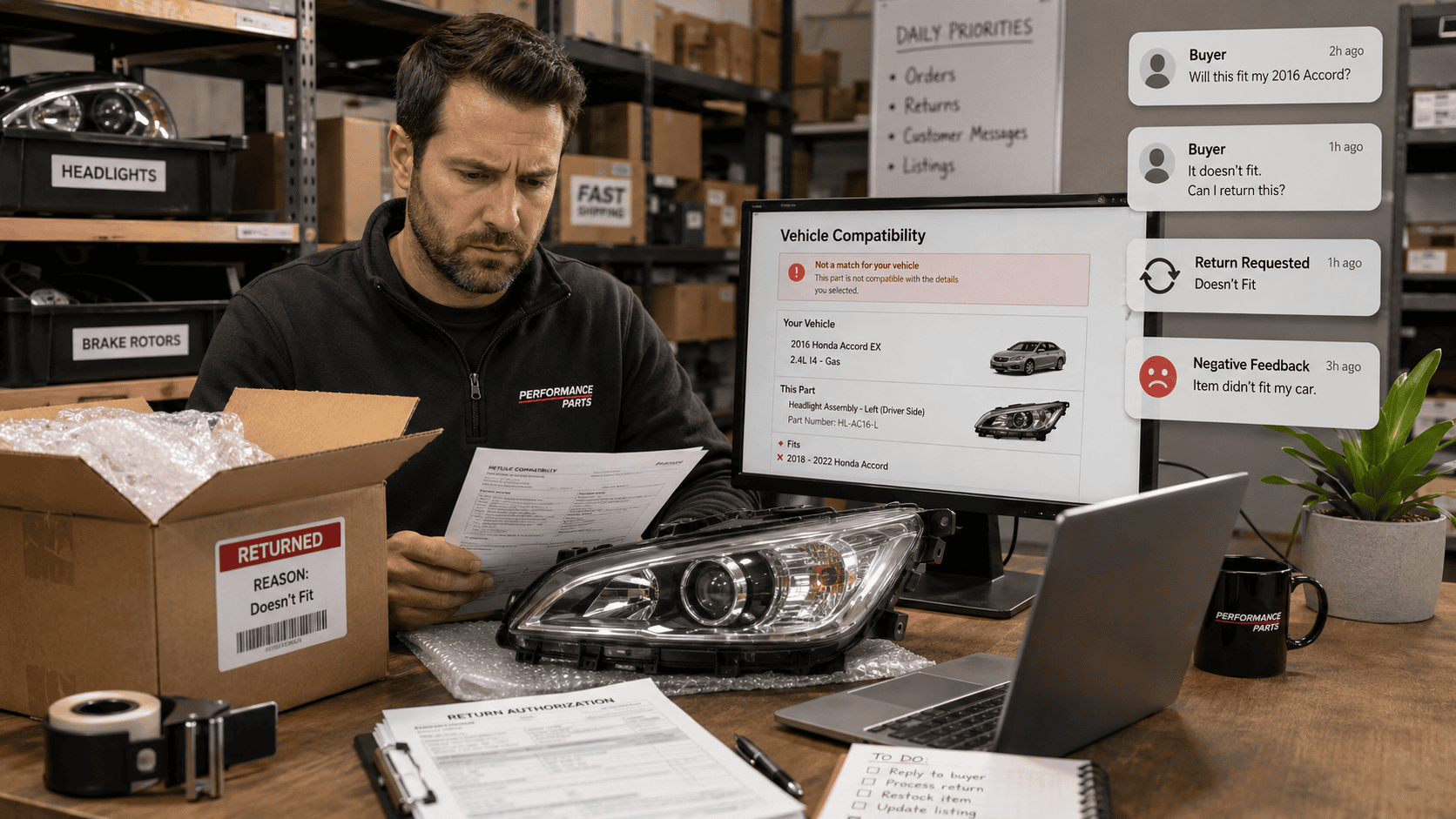
Incorrect or questionable fitment can generate additional buyer communication, slow purchase decisions, and create uncertainty about whether the listed part is actually appropriate for the vehicle.
Then, if the buyer purchases the wrong part, the cost increases considerably.
The seller may face:
- a "doesn't fit" return,
- buyer communication,
- return shipping,
- inspection and restocking,
- inventory being unavailable during the return,
- opened or damaged packaging,
- the cost of selling the same item again,
- and potentially negative feedback when the buyer believes the seller supplied incorrect compatibility information.
For professional sellers processing a high volume of orders, even a relatively small fitment-error rate can become expensive.
That is one reason eBay specifically cited reducing costly returns when it acquired myFitment.
Making returns easier is useful.
Preventing the wrong purchase in the first place is better.
What Sellers Have Said About myFitment
Public seller feedback on myFitment has been mixed. Some users praise the platform for making large-scale compatibility management possible, while others complain about slow or buggy workflows, weak customer service, outdated or minimal tutorials, and documentation that no longer matches current eBay pages or processes. Sellers have also reported that not all of their eBay listings appear inside myFitment, that some listings are missing compatibility information, and that it's impossible to remove a specific incorrect vehicle, even after repeated “doesn’t fit” returns. Some sellers have also described myFitment as a tool they continued using largely because there were few serious alternatives for professional eBay fitment management.
Why Fitment Becomes an Operations Problem
At small scale, correcting compatibility manually may be manageable.
At professional scale, it is very different.
A seller with 50 listings can review them one by one.
A seller with 50,000 listings cannot realistically investigate compatibility manually every time data changes, a vehicle application is missing, or a catalog source conflicts with what the seller knows about the part.
That is when fitment stops being simply a listing feature and becomes an operational system.
Professional sellers need to know where their compatibility data comes from, which listings may contain missing or questionable fitment, how changes are being applied, and how corrections can be made across a large catalog.
That need becomes even more important when the platform currently managing part of that workflow is about to close.
Four Signs It's Time to Upgrade Your Fitment Workflow
Before September 30, professional sellers should ask themselves four simple questions:
Are we still fixing fitment manually?
Do we rely on compatibility data we cannot fully control?
Can we quickly find missing or incorrect fitment?
If any of those answers create hesitation, the myFitment shutdown may be more than a migration deadline.
It may be the right time to upgrade the entire compatibility workflow.
Migrating From myFitment to MyListerHub
For sellers preparing for the September 30 transition, MyListerHub provides several ways to move existing compatibility data.
MyListerHub can:
- import compatibility through CSV,
- import existing listing and compatibility information from eBay,
- provide assisted migration,
- and manually help with complex catalog migrations.
The goal is to avoid forcing professional sellers to recreate years of compatibility information listing by listing.
For businesses managing thousands or tens of thousands of products, migration should be treated as a structured data project rather than a last-minute account change.
Read the complete guide: How to Migrate From myFitment to MyListerHub
Where MyListerHub Fitment & Compatibility Intelligence Fits
MyListerHub takes a broader approach than treating fitment as a separate database.
Fitment & Compatibility Management is connected to the listings, inventory, and catalog operations that use the data.
The platform includes capabilities for:
- fitment editing,
- bulk compatibility management,
- reusable compatibility structures,
- custom compatibility IDs,
- vintage vehicle applications,
- OEM supersession management,
- and complex compatibility workflows.
It is designed around the needs of professional auto-parts businesses including:
- OEM dealers,
- manufacturers,
- salvage yards,
- New Old Stock sellers,
- aftermarket businesses,
- and used-parts sellers.
Fitment can then be managed alongside MyListerHub's broader eBay tools, including listing creation, inventory management, HTML templates, bulk listing operations, and Listing Cycles.
Listing Cycles can be particularly valuable for long-tail auto-parts inventory.
A perfectly good component may fit dozens or hundreds of vehicles but remain unsold for months. Sellers can use Listing Cycles to automatically refresh aging listings based on their own rules instead of allowing old inventory to sit untouched indefinitely.
MyListerHub primarily serves professional sellers managing approximately 5,000 to 50,000 listings, while also supporting sellers starting around 1,000 listings and enterprise catalogs exceeding one million listings.
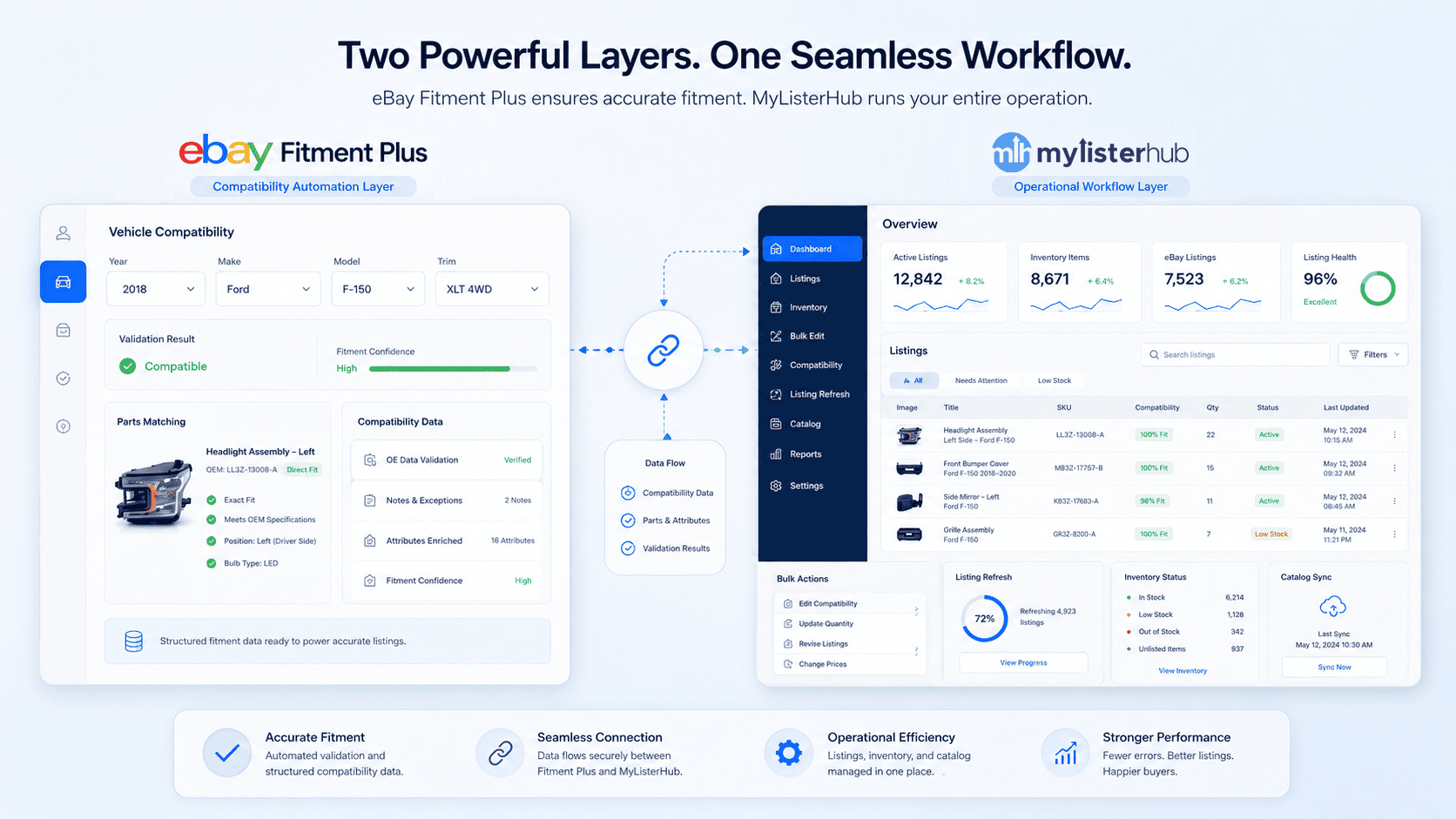
Read more: MyListerHub Fitment & Compatibility Intelligence for Professional Auto Parts Sellers
September 30 Is About More Than Replacing myFitment
eBay fitment is not disappearing.
Fitment Plus Auto represents eBay bringing more compatibility intelligence directly into its marketplace, and for many products, that automation can save significant time.
But professional sellers still need control over the compatibility attached to their inventory.
They need to know:
- what fitment is being applied,
- whether it is correct,
- where that data came from,
- and how quickly problems can be corrected across a large catalog.
That is why the September 30 transition should not be viewed simply as the loss of another software account.
It is an opportunity to decide whether the current fitment workflow is actually good enough for the size and complexity of the business today.
If myFitment currently plays a central role in your operation, September 30 should not be the day you begin searching for an alternative.
It should be the deadline for already having your migration strategy in place.
Common Questions Professional Auto Parts Sellers Ask About myFitment Shutting Down
Is eBay shutting down myFitment?
myFitment is expected to stop operating as a standalone service on September 30, 2026 as eBay shifts more of its compatibility technology into Fitment Plus Auto. eBay vehicle compatibility itself is not shutting down.
What does myFitment shutting down as a standalone service mean?
It means the separate myFitment platform is expected to close. Sellers will no longer use myFitment as an independent environment for managing compatibility, while eBay will continue providing vehicle compatibility through its own Fitment Plus technology.
Is eBay Fitment Plus always accurate?
No. Fitment Plus can automate a significant amount of compatibility work, but errors and missing applications can still occur. eBay tells sellers that they remain responsible for the compatibility associated with their listings and recommends reviewing automatically applied fitment.
Can I migrate myFitment data to MyListerHub?
Yes. MyListerHub supports importing Fitment data, CSV compatibility files, and existing eBay listing information. Assisted and manual migration options are also available for larger or more complex catalogs.
Does MyListerHub replace eBay Fitment Plus?
Not necessarily. MyListerHub can complement eBay Fitment Plus by giving professional sellers additional control over compatibility and connecting fitment management with listings, inventory, and broader catalog operations.
Who is MyListerHub Fitment & Compatibility Management built for?
It is designed for professional auto-parts businesses including OEM dealers, manufacturers, salvage yards, New Old Stock sellers, aftermarket sellers, and used-parts businesses managing large eBay catalogs.

by Jack Blum
by Jack Blum
Get More eBay Seller Updates
Follow MyListerHub as a preferred source on Google and see more of our eBay seller news, guides, and industry updates.