The Fastest Way to Turn Amazon Return Pallets Into eBay Listings
Learn how professional eBay sellers process Amazon return pallets, reduce inventory backlog, create eBay listings faster, and maximize recovery rates from liquidation inventory.
June 8, 2026

How to Sell Amazon Return Pallets on eBay Faster and Increase Recovery Rates
The Real Challenge Isn't Buying Amazon Return Pallets. Professional Amazon return pallet sellers already know how to source inventory. The challenge is what happens after the pallet arrives.
Every pallet contains a mix of products that must be identified, evaluated, priced, photographed, listed, stored, shipped, and managed. Some items are open box. Some are customer returns. Some are incomplete. Others have never been opened.
While that inventory sits waiting to be processed, another pallet is already on the way.
The fastest-growing liquidation businesses are not necessarily the ones buying inventory at the lowest cost. They are the ones converting Amazon return pallets into eBay listings faster than their competitors.
In the liquidation business, inventory sitting on a shelf earns nothing.
Inventory listed on eBay has an opportunity to sell.
That difference is everything.
Why Inventory Backlog Destroys Recovery Rates
Most Amazon return inventory is purchased for pennies on the dollar. The profit opportunity is obvious.
The problem is inventory backlog. Many liquidation operators purchase inventory faster than they can process it.
A pallet arrives.
Products are sorted.
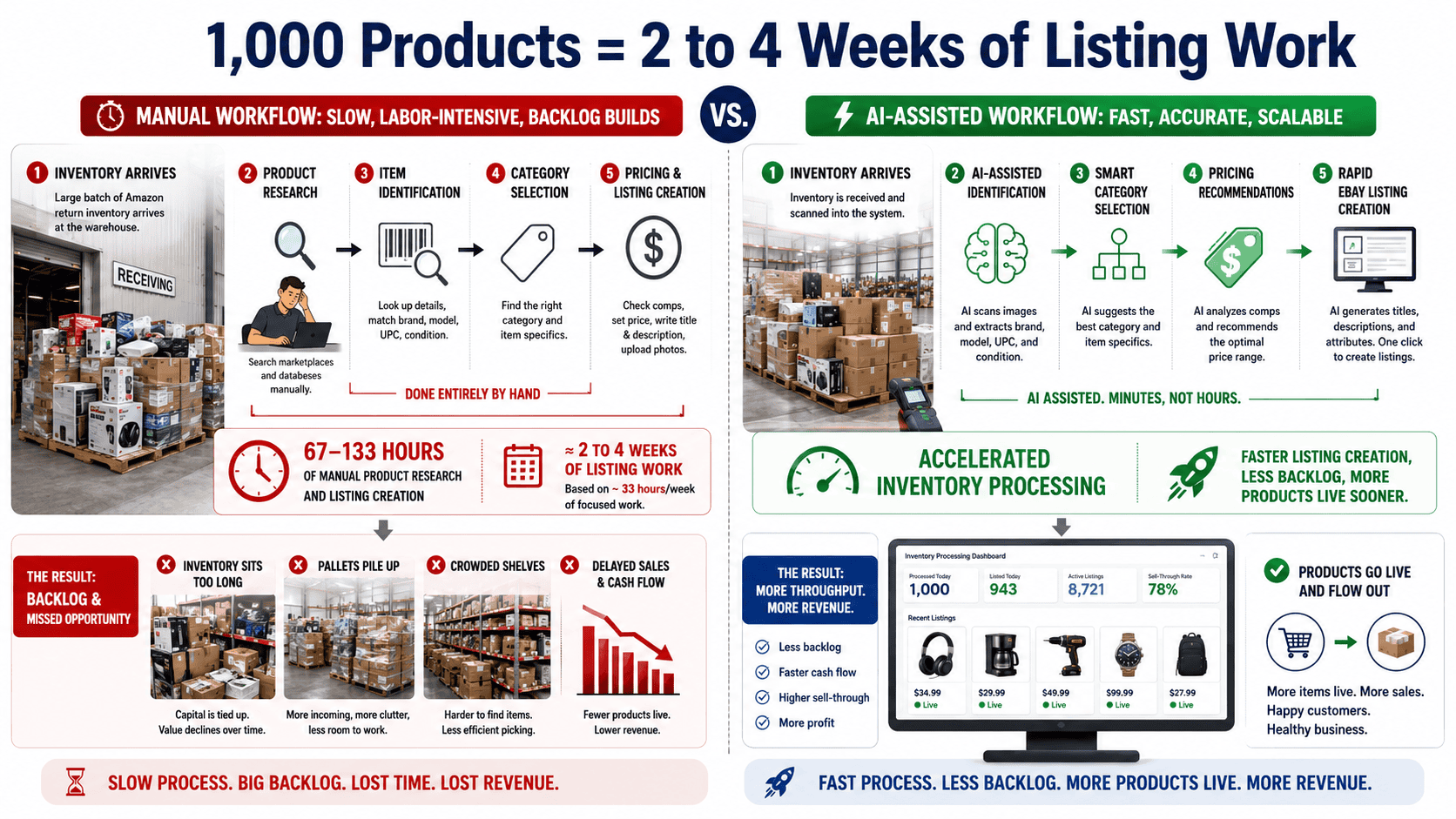
Employees begin researching products, determining values, selecting categories, filling item specifics, and creating listings.
Before that pallet is fully processed, another pallet arrives.
Then another.
Eventually, inventory begins piling up inside the warehouse.
The longer inventory sits, the greater the risk that:
- Products become outdated
- Seasonal demand is missed
- Inventory gets misplaced
- Storage costs increase
- Employees spend time handling the same products repeatedly
- Products are eventually donated, liquidated again, or discarded
Professional sellers understand that every day inventory sits unlisted reduces its opportunity to generate revenue.

The Hidden Cost of Spending 5 to 10 Minutes Per SKU
Most experienced liquidation sellers can create a listing in approximately 5 to 10 minutes.
That includes:
- Product identification
- Pricing research
- Category selection
- Item specifics
- Title creation
- Listing review
For a pallet containing 1,000 unique products, that translates to approximately 80 to 160 hours of labor, or roughly 2 to 4 full-time workweeks.
The problem isn't the time required to process one product.
The problem is multiplying that process across thousands of unique SKUs while new inventory continues arriving every week.
Many operators attempt to solve this by hiring more employees.
Others sacrifice listing quality by using generic titles, missing item specifics, poor photos, or aggressive pricing.
Neither approach fully solves the bottleneck.
The most successful operators improve the process itself.
Why Professional Sellers Focus on Process Instead of Individual Listings
Traditional eBay advice often focuses on optimizing individual listings. That works when inventory is replenishable.
Amazon return pallets are different. A single pallet may contain dozens of Apple products, but every item could be a different model, storage size, color, condition, or generation. Many products may never appear in inventory again.
Professional liquidation sellers are not spending weeks optimizing a single SKU. They are focused on inventory flow.
Their goal is to move products from receiving, to listing, to sale as quickly and efficiently as possible.
How MyListerHub Helps Sellers Process Amazon Return Inventory Faster
This is where automation becomes valuable.
Instead of manually researching every item, many sellers are now using AI-powered inventory processing tools to accelerate listing creation.
MyListerHub's Cavio AI was built specifically to help sellers process inventory faster.
A seller can upload product images, and Cavio AI will generate:
- Product titles
- Categories
- Item specifics
- Descriptions
- Pricing recommendations
Instead of spending several minutes manually researching each product, sellers can review the generated information and move inventory through the listing process significantly faster.
For sellers processing hundreds or thousands of products every month, reducing listing time by even a few minutes per item can save hundreds of hours annually.
More importantly, inventory reaches eBay sooner.
Hundreds of eBay sellers currently use MyListerHub and Cavio AI as part of their daily inventory processing workflow to reduce listing bottlenecks and increase listing throughput.
Learn more about how Cavio AI converts product photos into eBay-ready listings with MyListerHub's Photo to eBay Listing AI solution.
Getting Inventory Listed Is Only Half the Battle
Creating eBay listings is only the first step. Not every product sells immediately. Some products sell within days. Others remain active for months.
As inventory ages, products often become buried beneath newer inventory. Warehouse shelves become crowded. Employees focus on newer arrivals. Older inventory slowly becomes forgotten.
Many liquidation sellers eventually discover that their biggest challenge is no longer creating listings.
It is keeping inventory moving.
Why Stale Inventory Becomes Expensive Inventory
Every liquidation warehouse has it.
The shelf contains products that have been sitting for months.
Nobody remembers when they arrived.
Nobody remembers which pallet they came from.
Nobody remembers how much was paid for them.
Meanwhile, they continue consuming valuable warehouse space.
This is one reason many sellers use MyListerHub's stale-listing refresh automation.
Instead of allowing aging inventory to sit untouched, listings can be refreshed through automated workflows that keep inventory active and visible on eBay.
For sellers managing thousands of listings, manually reviewing every aging product is rarely practical.
Automation helps reduce that workload while giving older inventory another opportunity to sell.
Many high-volume eBay sellers rely on these workflows as part of their ongoing inventory management strategy.
Learn more about how MyListerHub's Listing Cycle helps sellers refresh stale listings automatically.
The Fastest Way to Turn Amazon Return Pallets Into eBay Listings
The most successful Amazon return pallet sellers are not necessarily the ones buying inventory at the lowest price.
They are the ones with the fastest inventory flow.
They process inventory quickly.
They reduce research time.
They eliminate bottlenecks.
They use technology to increase listing throughput.
They keep inventory moving.
And they avoid allowing valuable products to disappear into warehouse shelves.
In today's liquidation market, the competitive advantage is no longer finding inventory.
The competitive advantage is turning Amazon return pallets into eBay listings before the next pallet arrives.
Common Questions Amazon Return Sellers Ask
How do professional sellers process Amazon return pallets into eBay listings so quickly?
Professional sellers focus on inventory flow rather than perfecting individual listings. Instead of manually researching every product, many use AI-powered inventory-processing tools to identify products, generate titles, fill in item specifics, suggest categories, and create eBay listings faster. The goal is to reduce inventory backlog and get products live before the next Amazon return pallet arrives.
How long does it take to list products from an Amazon return pallet?
Most experienced liquidation sellers spend between 5 and 10 minutes per product on researching, pricing, categorizing, and manually creating eBay listings. For a pallet containing 1,000 unique items, that can require 80 to 160 hours of work. This is why many high-volume sellers use automation tools to reduce listing time and increase inventory throughput.
What is the biggest mistake Amazon return sellers make on eBay?
One of the biggest mistakes is allowing inventory to sit unlisted. Every day a product remains in a warehouse, it consumes storage space, delays cash flow, and increases the risk of becoming outdated, misplaced, or forgotten. Successful Amazon return-pallet sellers prioritize listing inventory quickly while maintaining accurate product information.
How do sellers keep Amazon return inventory from becoming stale on eBay?
Many sellers use stale listing refresh strategies to prevent older inventory from being buried beneath newer listings. Refreshing aging inventory, improving listing data, and revisiting slow-moving products can help keep inventory active and selling. Automated stale-listing refresh tools are commonly used by high-volume eBay sellers who manage thousands of listings.
What is the best marketplace for selling Amazon return pallets?
For many liquidation sellers, eBay remains one of the best marketplaces for Amazon return inventory because it supports open-box, used, refurbished, and parts-only items. It also allows sellers to list a wide variety of unique products that may never be restocked, making it particularly well-suited for Amazon return pallets and liquidation inventory.

by Alon Dostov

by Alon Dostov
Get More eBay Seller Updates
Follow MyListerHub as a preferred source on Google and see more of our eBay seller news, guides, and industry updates.